|
About Our Lamb
This article was from a Washing
ton Post story by M.J. McAteer.
A
Thanksgiving stuffing made with locally available Loudoun lamb
sausage can be on your holiday menu as long as you're up for a
drive through hunt country. Just stow a cooler in the car and head
to Linda Landreth's Waterford Market, about 45 miles from Washington
in Loudoun County.
Hers is the only year-round retail location in Northern Virginia
that sells Loudoun
Valley Sheep Producers Association sausage
($8 for a one-pound package of frozen links). Landreth's lamb
links (try saying that three times fast) are savory and sweet,
made from all-prime-cuts meat. The sausage is hormone- and antibiotic-free,
with the lambs raised mostly in the open and grass-fed. The handling
of their demise is done "humanely" at Wagner's Meats,
a family business in Mount Airy.
"I checked out local processors to the point where they
probably didn't want me to show up again," Landreth says
with a laugh.
The resulting sausage is mild. "I have yet to encounter
a kid who doesn't like it," says the shopkeeper-shepherd.
The sausage is lean, too, so it doesn't need to be simmered in
water to get rid of fat before it is fried, grilled or broiled.
Although it is a natural for breakfast, the sausage is good
served whole in sandwiches with a Vidalia onion dressing. Yogurt
mixed with chopped onion, garlic and dill also brings out the
flavor. Landreth serves the sausage in holiday hors d'oeuvres,
too. The links can be browned and sliced on the diagonal to be
served with a dipping sauce or become a hearty spread themselves
if the loose meat is removed from the casings, browned and combined
with herbs and feta cheese. Or, of course, the sausage can go
into stuffing.
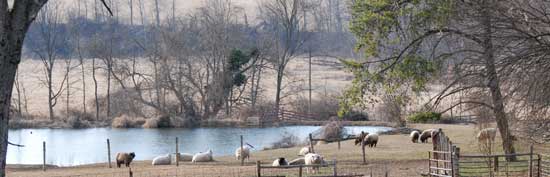
Landreth's own Corriedales and silver-blue Lincoln Longwools
graze right behind her Waterford Market, a testimony to how local
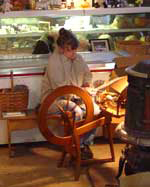
this product is. She also sells fleeces, hand-spun naturally
colored yarn and the wool hats and scarves that she knits from
that yarn in her store.
Loudoun Valley may be "one of the most fertile valleys
in the world," but a small farmer must be flexible to survive
amid the pressures of development, she says. Providing the missing
link in the food chain is one way to do so.

|